3 Sum Medium
Problem Statement
- Given a array of positive and negative integers
- We have to return the list all possible 3 numbers whose sum adds up to 0.
- Eg. For array [-1, 0, -2, 2, 1] the result is [ [-1, 0, 1], [ -2, 0, 2 ] ]
- Expected Time Complexity: O(n2), Expected Space Complexity: O(1)
Algorithm Overview
- First we need to sort the given array in ascending order.
- Once the array is sorted, we can iterate through the array with Pointer i.
- For each i, we declare 2 more pointers L and R
- Pointer L = i + 1
- Pointer R = arrayLength - 1
- For each i, we check if the sum of elements at pointer i, L and R becomes zero.
- If yes, we got a result.
- If not:
- If Sum > 0, reduce pointer R by 1, this would reduce the sum (Sorted Array)
- If Sum < 0, increase pointer L by 1, this would increase the sum (Sorted Array).
- This process is repeated for each iteration until L crosses R (L > R).
Example
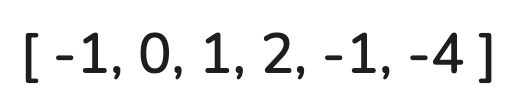
Let us consider the following array as an example.
Step 1
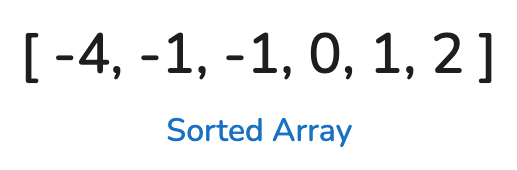
Firstly, we need to sort the array in ascending order.
This would take O(log n) or O(n2) by using even the worst algorithm.
Step 2
Iterate through the array and for each element, we need to find the combination of 2 elements that adds up to 0.
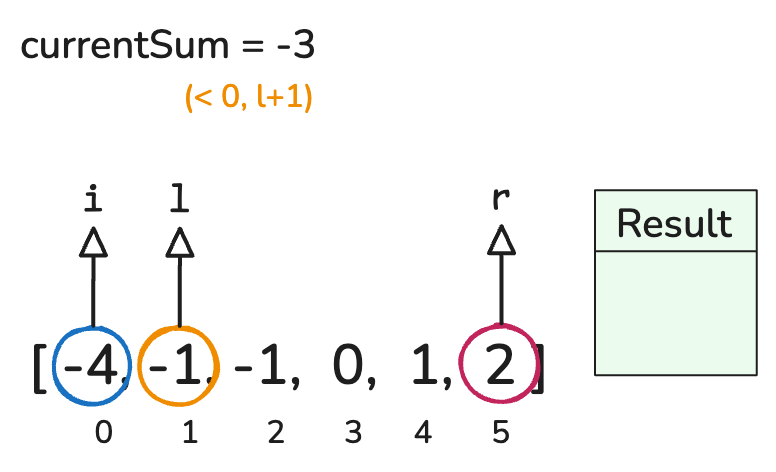
We start with index i, for each i, we declare pointers L and R which move towards right and left respectively.
- We check if the sum of elements at indices i, L, R add up to 0. If yes, we add the elements to the result.
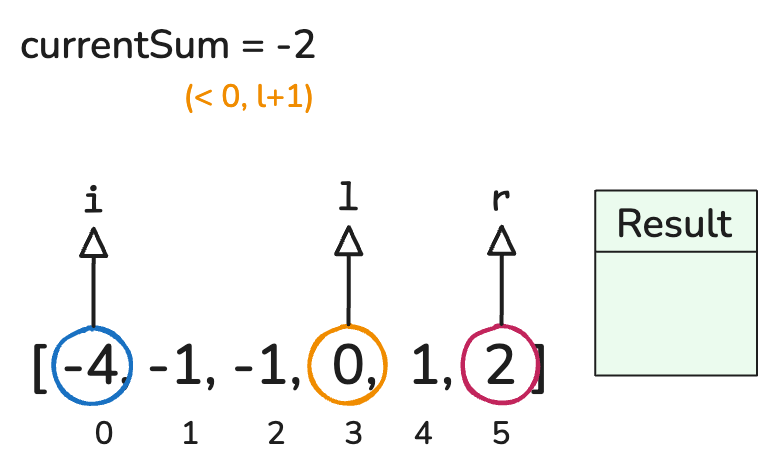
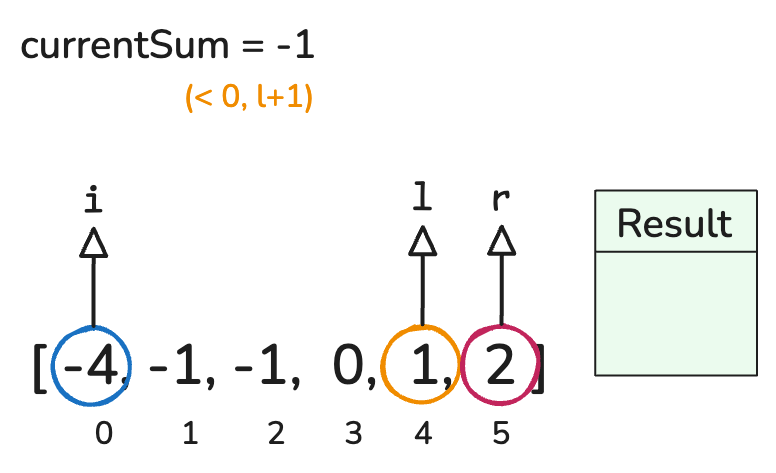
- If sum < 0, we increment pointer L, Increasing L will increase the sum since the array is sorted.
- If the sum > 0, we decrement pointer R, Decreasing R will reduce the sum value.
We repeat this loop for each i until pointer L crosses the pointer R.
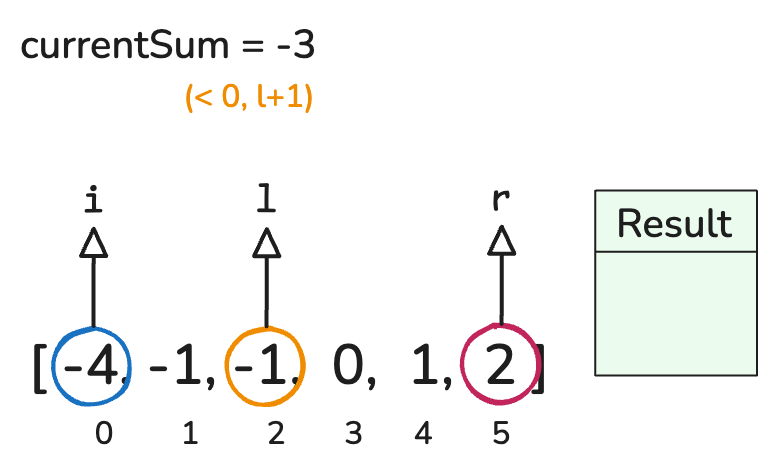
Sum is still negative, we move the pointer L towards the right to increase the sum.
Sum is still negative, Moving pointer L to the right.
Sum is still negative, Moving pointer L to the right.
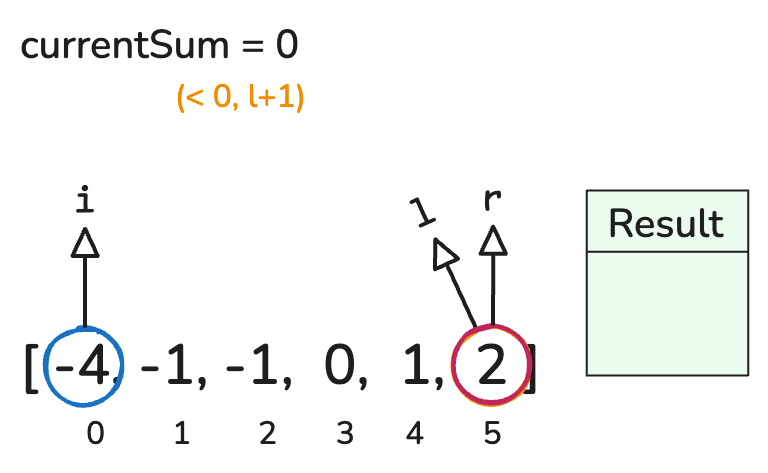
Here, the sum has reached 0, but Pointer L has reached Pointer R, so we can’t use this result. The result comprises 2 numbers but from the same index.
Hence we move to the next iteration by incrementing Pointer i.
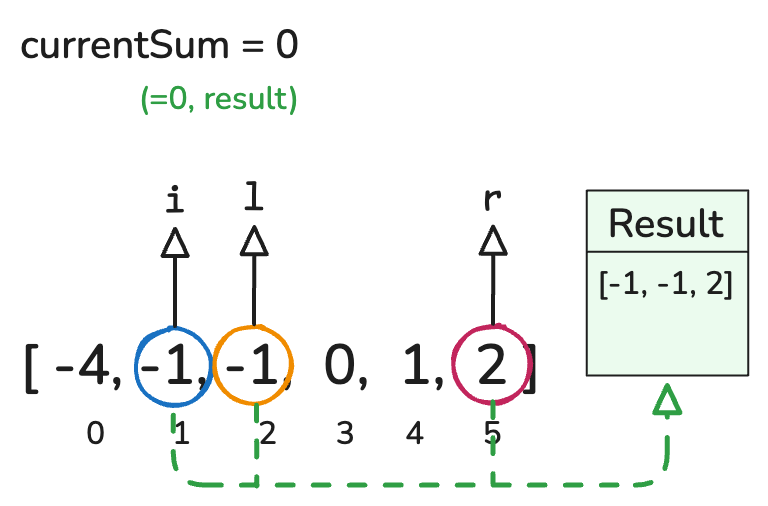
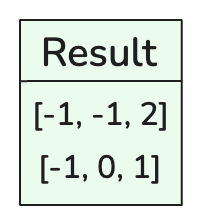
Here, we hit a sum of 0, so we can now add the found numbers into the result set and proceed by incrementing both pointers (L and R).
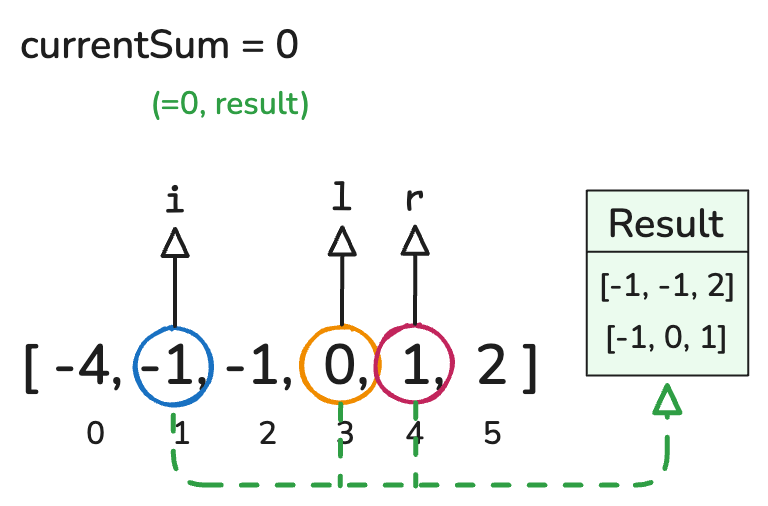
We have found another result, adding them to the result set.
Incrementing both pointers (L and R).
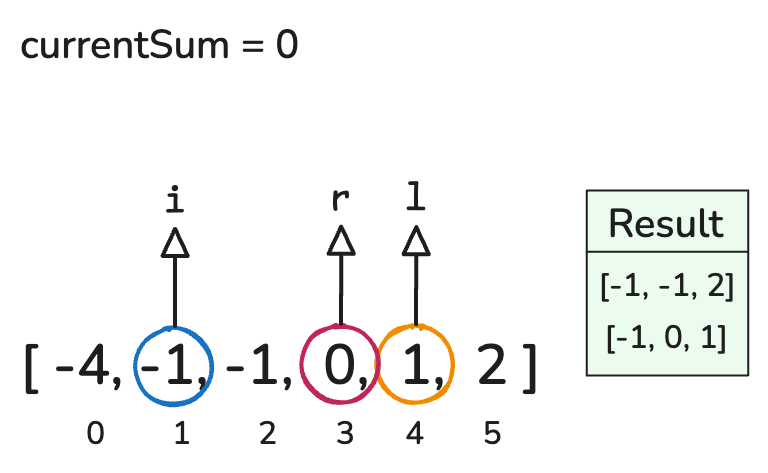
Here, L has crossed R, hence we go to the next iteration by incrementing pointer i.
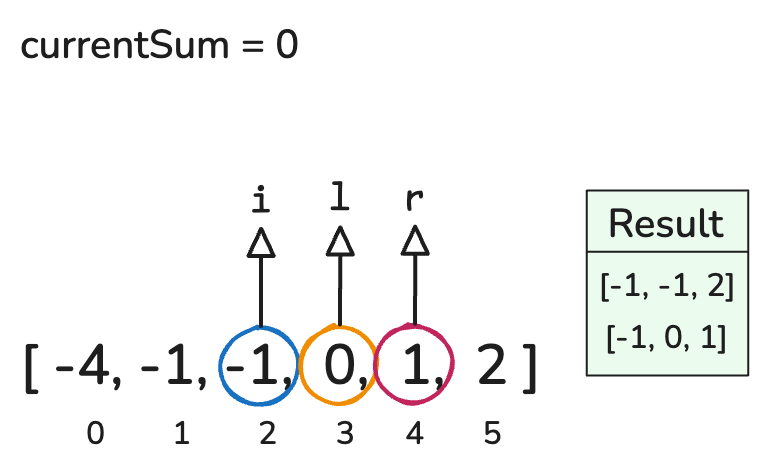
Here, the element at i is the same as the element at i-1.
Proceeding with this iteration will result in a duplicate result as we have already run the iteration for element at i being -1. Hence we skip the iteration in this case.
- Skip the iteration if arr[i] == arr[i-1]
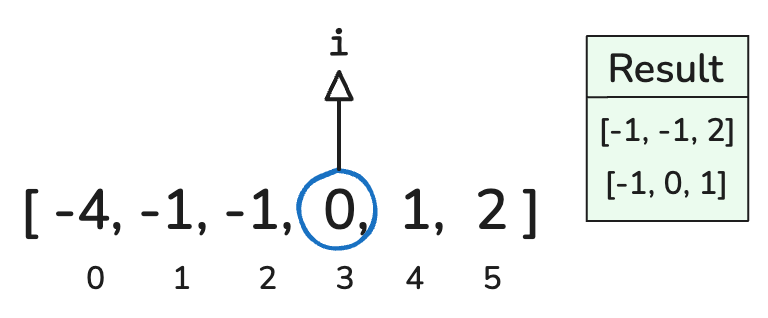
Here, the element at i has become positive, we need at least one negative element to derive a 0 sum. It is not possible now as the element at i has become positive and also the elements after i shall also be positive (Sorted Array). So we end the iteration and return the result set at this point.
Code
class Solution {
    public List<List<Integer>> threeSum(int[] nums) {
        Arrays.sort(nums);

        List<List<Integer>> result = new ArrayList<>();

        for(int i = 0; i < nums.length; i++) {
            if (nums[i] > 0) break;
            if (i > 0 && nums[i] == nums[i-1]) continue;

            int l = i + 1;
            int r = nums.length - 1;

            while (l < r) {
                int sum = nums[l] + nums[r] + nums[i];
                if (sum == 0) {
                    result.add(Arrays.asList(nums[i], nums[l], nums[r]));
                    l++;
                    r--;
                    while (l < r && nums[l] == nums[l - 1]) l++;

                } else if (sum > 0) {
                    r--;
                } else if (sum < 0) {
                    l++;
                }
            }
        }

        return result;
    }
}